Monday, July 7, 2014

A furtive look back at the Seebackroscope

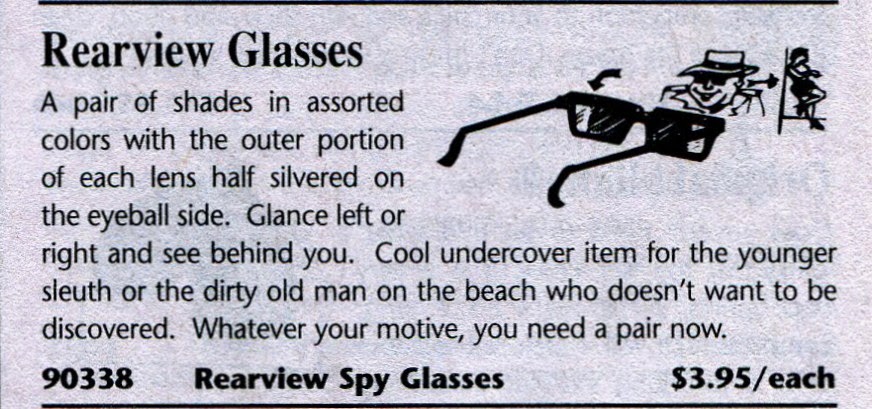
A look back at a novelty designed to look back.  Advertised in magazines, catalogs, and comics, these see-back scopes and glasses lack the iconic gravitas of X-ray scopes, gogs, etc., yet the basic see-back gimmick has endured for more than a century.  That makes it something other than an example of pop culture ephemera, since the concept keeps on going, with never a backward glance.  That's always the problem--disposable novelties cry out to be labeled as ephemera, but how can things that never go away be rightfully called ephemera?  Think about it!  Kind of scary, really.

I'm guessing these devices, like most novelty-ad trinkets, don't work very well.  Which is probably a good thing, since reverse vision is a liability for anyone walking forward, especially upon crossing the street, encountering stairs, approaching an open manhole, etc.  ("Wow, look at tha....  AIEEEEE!!!"  CRASH!)

Ads are from The American Boy, Fightin' Air Force (Charlton). a Greenland Studios gift catalog, U.S. Air Force (Charlton), and the May, 2014 American Science and Surplus catalog.  In that order.  Apologies for the gaps in the evolutionary record.  I'll stay on the look-back--I mean, the lookout--for more examples.


1903:  

1956:

c. 1963: 

                                                                   1964:

2014:


Lee

Wednesday, July 2, 2014

Montages--examples from 1880, 1887, and 1890

I call these "montages."  If there's an actual, official name for them, I'd love to know.  Anyway, I've been encountering them constantly in magazines of the late 19th century, and they're so tantalizingly close to 20th-century comic book layouts, I want to call them comics.  Certainly, they'd be at home in a modern Sunday comics section.

Observe the way that text and art intertwine--interact, even--in these.  A bridge between early comic strips and modern comic magazines?

From 1887 issues of The Youth's Companion, an 1880 issue of Golden Hours, and the Feb., 1890 issue of Wide Awake.  Coolest of all is the third Youth's Companion piece, "The Pussy and the Turtle," which looks (and reads) like Dr. Suess!

Scans by me from magazines in my overflowing collection:


The Youth's Companion, Oct. 29, 1887 (above).


The Youth's Companion, Oct. 6, 1887 (above).


The Youth's Companion, June 16, 1887 (above).


The Youth's Companion, May 12, 1887 (above).  How close to a comic book page can something get?  


Golden Hours, October, 1880 (above).  Situated in the middle of a short story.  Note the bulletin board motif!  It features characters and scenes from the text. 


Wide Awake, Feb., 1890 (above).  This cries out to be converted to modern comic book format! 


Lee

Tuesday, July 1, 2014

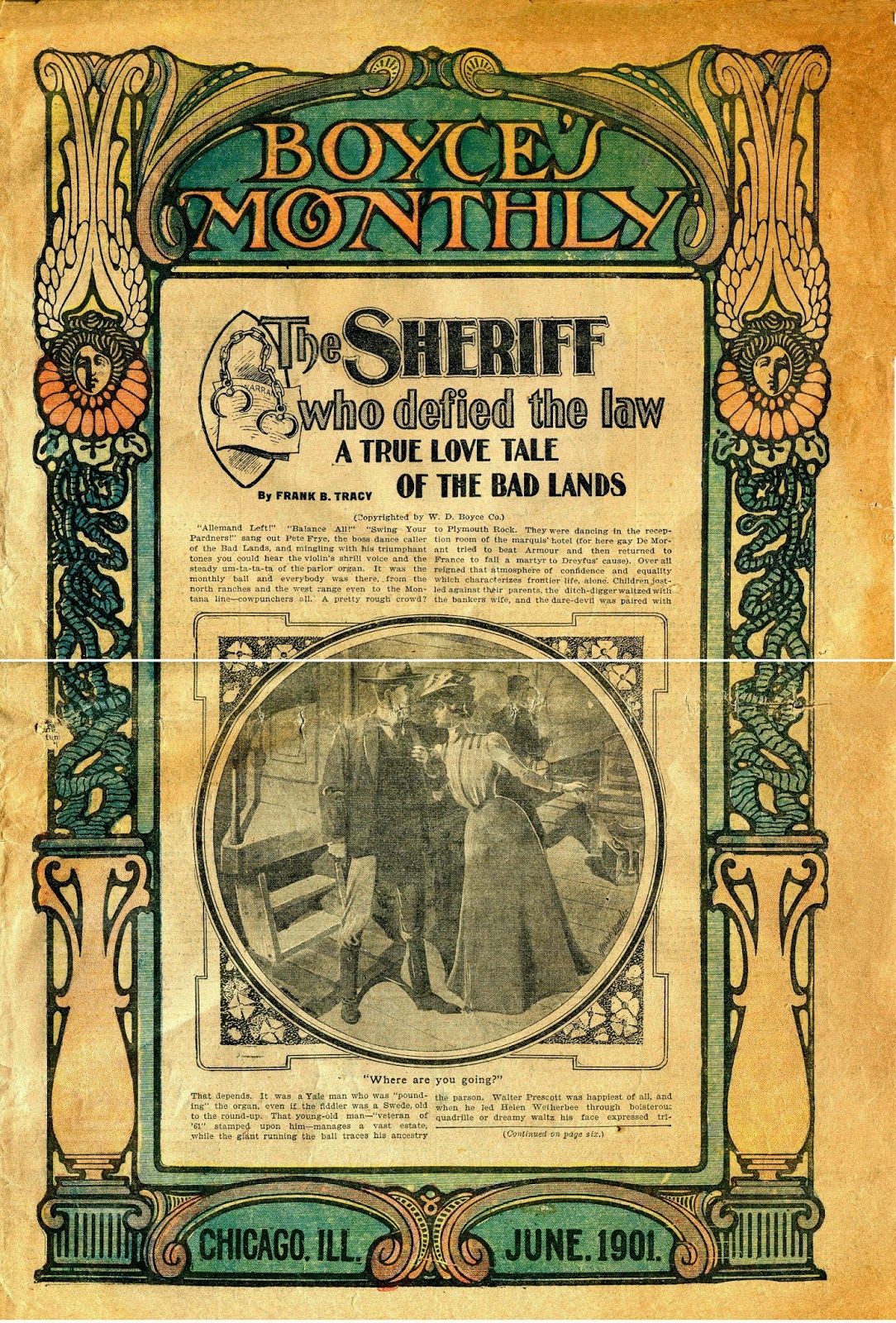
Cartoons from the June, 1901 Boyce's Monthly


s

Yet another "X-ray" novelty--this time, 1901's X-Ray Cathodoscope

From Boyce's Monthly, June, 1901. I'm betting this is yet another take on the X-ray Wonder Tube.  "Tells time on watch through cloth"?  Possible meaning: The X-Ray Cathodoscope can see through cloth, at least when the cloth is covering the face of a watch.  That's my guess.  Actually, "tells time on watch through cloth" sounds like something out of a magic act.

Yes, the highly cheap paper is as yellow(ed) as it appears in the scans.


Friday, June 27, 2014

More X-ray vision!! Tubes, cards, and stove polish.


The see-through saga continues with these fascinating finds (Well, I think they're fascinating....), all of which serve to remind us that X-ray specs, gogs, and whatnot predate comic books by decades, despite their "iconic" connection with same.  X-ray vision was, in fact, originally the stuff of newspapers, family magazines, novelty catalogs, and Popular Mechanics.  Now you know.

First up, the "X=ray Wonder" from the C. Armstrong Co., which might be the monocular postcard I showed last time--just a guess.  I found this ad hiding in the same November, 1908 Home Life magazine that gave us all those genteel and refined "cuts" of two posts back.


Then, from eBay (see the lower-right-hand logo), a made-in-Japan X-Ray tube that may (or may not be) from the 1950s.  Didn't bid on it, but almost did.


I did bid on, and win, this next one--a stereo X-ray Post Card (X-ray Card Co., Brenham, Texas) from on or about 1910.  With it, I experienced my first-ever instance of "X-ray" vision, which can only be gotten against a very bright light source (as in, a window facing the sun).  Is it a convincing effect?  Only if, by "convincing," you mean utterly fake.


From the same 1908 Home Life as the "X=ray Wonder," an ad cut for X-ray Stove Polish.  "Shines brightest."  Fine, but can you see the bones in the stove?  That's what we want to know.


Lastly, typical 1907 racism on a 1907 X-ray card--this time, from our friends at Cunningham & Co., Williamsport, Pa.  Featured at eBay.  Those of us who collect old magazines and sheet music see this sort of imagery pretty constantly:


Lee


Wednesday, June 25, 2014

Near-comic strip: Bertie and His Sled (1875, 1884)

Today, we have a near-comic strip called Bertie and His Sled, scanned by me from Sunshine for Little Children (The Sunshine Press, Philadelphia,1884).  This had previously appeared in 1875 as a three-paged feature in The Nursery.  Note that the panels are arranged top to bottom in three rows; reading from left to right throws the tale out of order.  Printed full-page and in three sections for your near-comic strip reading pleasure:


Lee

The folks of 1908 were soooooo genteel....

Some ads from the November, 1908 Home Life, scanned by your blogger:


   Works better than stabbing yourself in the eye!   Was a young Mario Bava inspired by this?  (Likely not--he wasn't born until 1914.) (Above)


So much for the idea that no one knew smoking was dangerous until Koop pointed it out.... (Above)


What you could get for free back in the day.... (Above)


Indeed--thin cheeks, neck, and arms look totally wrong with a big bust.  Oh, wait, this is 2014.  I mean, those things look perfect with a big bust.  (Above)


"Superior to any other $3 syringe."  Not for use by unmarried women.  (Above)


Too thin?  Maybe she took the remedy in the next ad!


Oddly enough, the issue didn't also run a "Too Medium?" ad cut. (Above)


A quick Google search reveals that "k'hawking and spitting" was a common phrase 100+ years ago, at least in ads.  What's Jimmy Fallon doing in this 1908 ad??? (Above, right)


"Thanks, honey, that was good coffee.  Hold on a minute--I'm no longer a drunkard!" (Above)


"And we can prove it... with this outrageously fake photo!"

Nothing candid, blunt, to-the-point, direct, or frank about these 1908 ads.  Such a refined era would never have allowed such things, especially in a family magazine....


Lee